
dsh-session-tree-extension
In a curated listMaintenance: Activerobiteame/dsh-session-tree-extension
dsh-session-tree-extension Append-only, multi-branch conversation trees for DeepSeek-Harness — a PI-Agent-style SessionTree. The agent's history becomes a tree of immutable nodes, forkable at any historical node, with standard LLM message reconstruction, versioned JSON snapshots, and a WebUI tree panel embedded in the existing chat composer (no sta
$ dsh plugin add dsh-session-tree-extensionInstall
dsh has no central install command — add this plugin’s entry (documented in its README) to your profile or patch config, then restart.
How installs work20
stars
1
forks
TypeScript
Language
MIT
License
2026-08-27
Created
2026-10-24
Last push
README
dsh-session-tree



Append-only, multi-branch conversation trees for DeepSeek-Harness — fork any historical node, clone a branch into a new session, and browse the whole lineage as one merged WebUI graph. Old history is never edited or deleted.
Three commands:
| Command | What it does |
|---|---|
/tree |
Open the merged lineage graph: every non-subagent session and node, clickable and bindable |
/fork |
Branch from any historical node — the fork appears in the graph and as an inline menu under its source session |
/clone |
Duplicate the current conversation into an independent new session under the same project |
Screenshots
Tree panel (light and dark) with the sidebar's inline fork-branch menu:
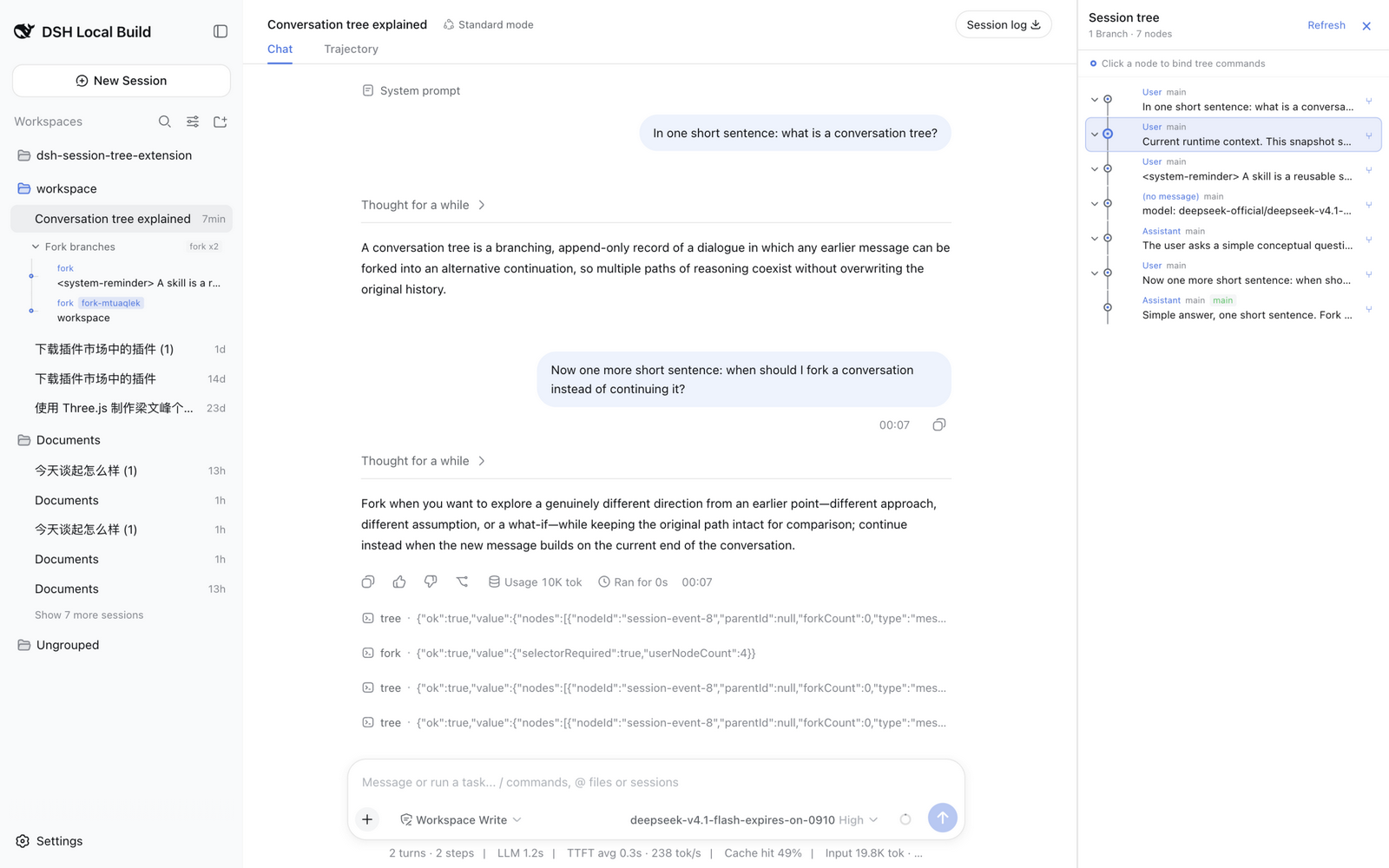
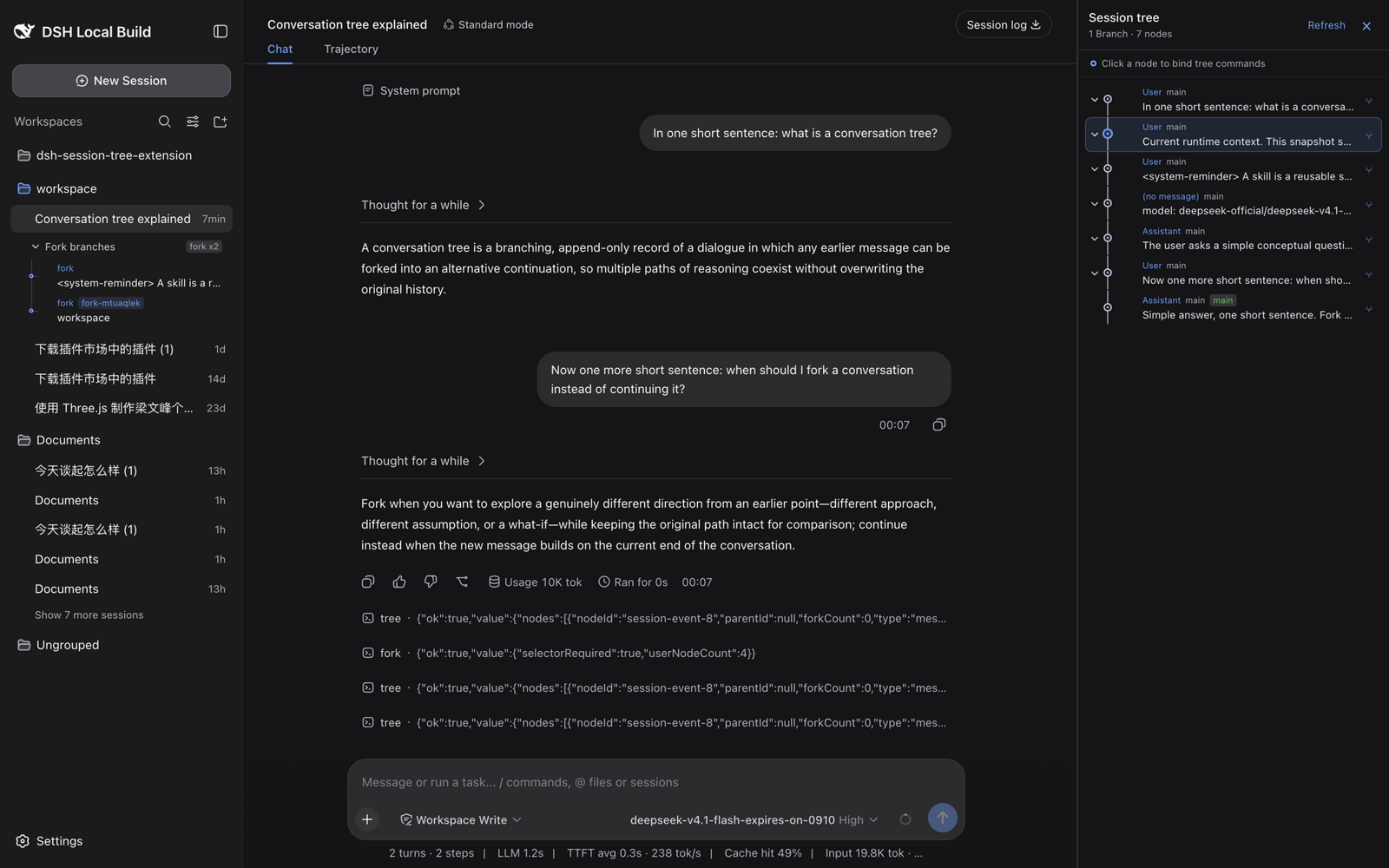
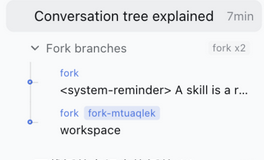
The inline /fork branch menu beneath its source session:
Published as four npm packages under the @robiteame scope:
| Package | Role |
|---|---|
@robiteame/dsh-session-tree |
Carrier Bundle: one install mounts everything below through its composition layer |
@robiteame/dsh-pi-agent-session-tree |
Host domain service: the SessionTree/SessionTreeStore domain model and the sessionTree Remote |
@robiteame/dsh-tool-session-tree |
Command surface: the /tree /fork /clone commands |
@robiteame/dsh-client-ui-session-tree |
WebUI tree panel: a native tab in the Harness 0.2 right Sidebar, with an additive overlay fallback for older stock builds |
Install (users)
DeepSeek Harness Desktop
Open Settings → Plugins → Market, search for
@robiteame/dsh-session-tree, install it, and restart the desktop app. The
desktop plugin manager activates the carrier bundle, so the next boot composes
the three rows (pi-agent-session-tree, tool-session-tree,
ui-session-tree) that load the Host service, the commands, and the browser
panel.
On older desktop builds bundling the 0.2.1-rc.2 CLI, the dsh plugin
command only forwards to pnpm and does not activate a newly installed bundle.
Use the in-app market there; after the restart, /tree opens the panel.
CLI (0.2.1-rc.3 and newer)
On a CLI that ships the 0.2.1-rc.3 plugin manager, one command installs and
activates the bundle:
dsh plugin --profile <profile> add @robiteame/dsh-session-tree
Prebuilt tarballs install the same way and need no build scripts:
dsh plugin --profile <profile> add robiteame-dsh-session-tree-0.7.2.tgz
After installing, restart the profile. Verify the composed layer:
dsh --profile <profile> --dump-config # should list the three session-tree rows
Requires DeepSeek-Harness ^0.2.1-rc.2 and Cordis ~4.0.5; the target
installation provides those peers. The current development and verification
baseline is the published 0.2.1-rc.5 release. No install
scripts run — the tarballs ship prebuilt lib/ artifacts.
The three commands
/tree — open the tree panel
/tree opens the right-side panel as one merged graph for the current
session's lineage: ancestors, forks, and clones appear in a single git-style
view, with user messages, assistant replies, tool calls, and model switches
shown as connected nodes. Shared copied prefixes are deduplicated, fork points
carry session badges, and the current session's path stays highlighted. Click
a node to bind it; clicking a node owned by another session opens that session
first. Collapse individual subtrees or whole session branches to focus the
graph.
/fork — branch from any historical node
/fork picks an earlier user prompt and grows a new branch from there: the
conversation continues along the new path while the original one stays intact.
The fork is created through the official native fork API, so it appears in the
session list with real parent linkage. The plugin adds the new branch to the
merged graph and also renders it as an inline collapsible menu directly beneath
its source session's row. Both views follow the official reactive session list,
so new branches appear without a refresh.
/clone — duplicate into a new session
/clone copies the current conversation — through its root path — into an
independent Session under the same project. The source history stays
read-only; the clone is yours to continue separately.
Branch switching and graceful degradation
The plugin never modifies Harness core files. It capability-detects the optional branch-selection engine API at runtime:
More in Agents, Automation & Workflows
archify
by tt-a1i
Turn any idea, plan, or codebase into a beautiful interactive diagram. An agent skill for Claude Code, Codex, and more.
openviking
by volcengine
Self-evolving Context Database for AI Agents. Unify Agent Memory, Knowledge RAG and Skills.
learn-harness-engineering
by walkinglabs
Harness engineering beginner tutorial, from 0 to 1
browserskill
by tencent
Let AI agents use your real, logged-in browser without interrupting your work. CLI + extension for browser automation across any shell-capable AI agent.