
oh-my-dsh
Maintenance: Activeagi-fans/oh-my-dsh
A focused, keyboard-first DeepSeek coding agent built on the plugin architecture of DeepSeek Harness and inspired by the interaction quality of oh-my-pi.
$ dsh plugin add oh-my-dshInstall
dsh has no central install command — add this plugin’s entry (documented in its README below) to your profile or patch config, then restart.
How installs work33
stars
4
forks
TypeScript
Language
MIT
License
2026-08-15
Created
2026-09-29
Last push
README
oh-my-dsh
Into the Unknown
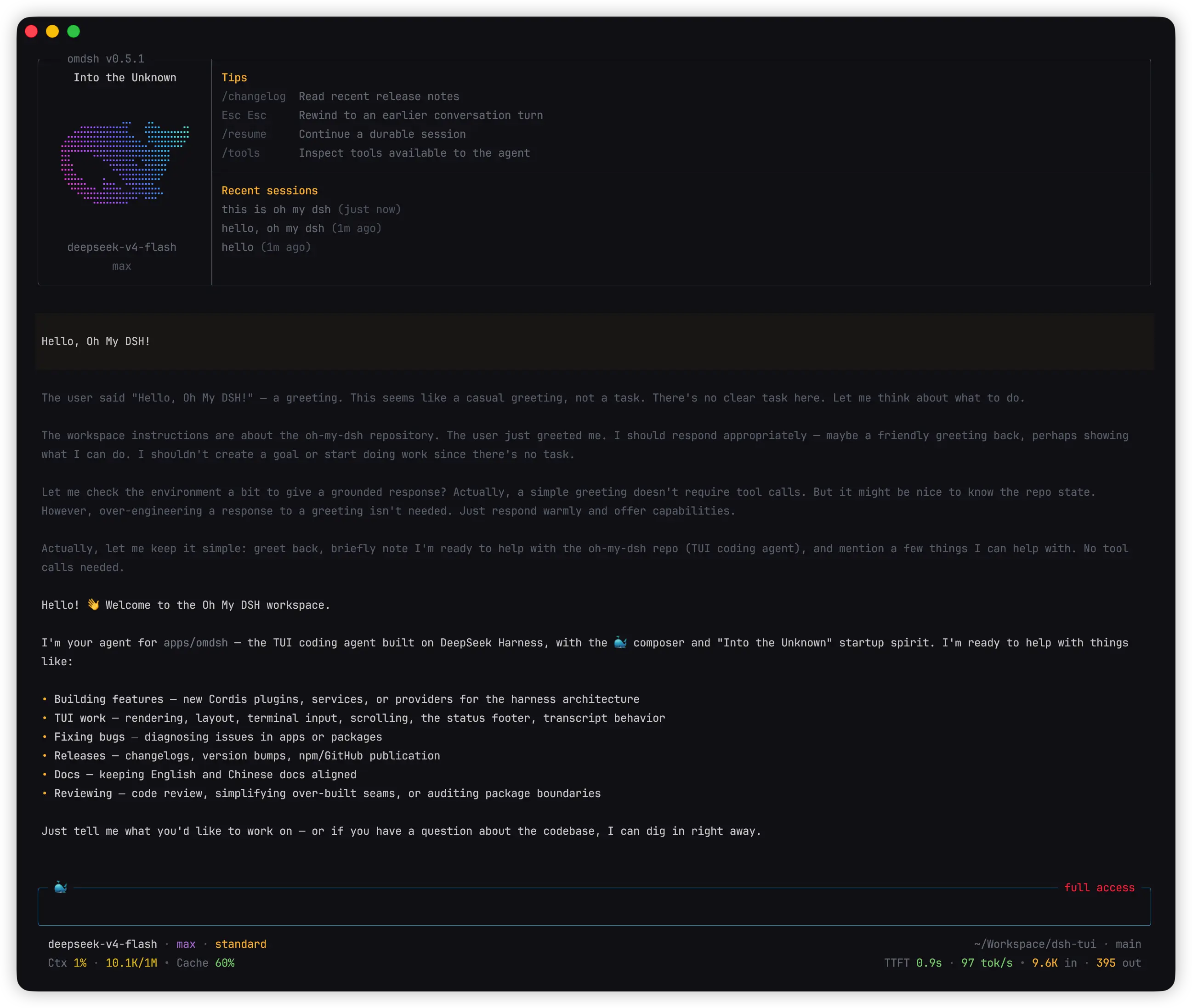
omdsh is a focused, keyboard-first DeepSeek coding agent built on the plugin architecture of DeepSeek Harness and inspired by the interaction quality of oh-my-pi and the original Pi agent harness.





Documentation · English · 简体中文
Quick start
Requirements: Node.js 22.19 or later in the 22.x line, or Node.js 24 or newer, plus a DeepSeek API key for live model turns.
npm install --global @agi-fans/oh-my-dsh
omdsh
Run /login once inside omdsh to validate and save your DeepSeek API key, then start a conversation. To try it without a global installation, run npx @agi-fans/oh-my-dsh.
Highlights
- Durable conversations: search, pin, rename, and resume sessions in
/sessions; rewind, retry, compact, and export complete transcripts as Markdown or standalone HTML. - Three real session controls: choose a Harness Agent preset (Standard, PTC, Minimal, or Cordis), Workflow (Default or Plan), and Access (Read only, Workspace write, or Full access). Each Agent preset owns its tool exposure; PTC uses the generated TypeScript SDK automatically.
- Rich terminal input: mention project files and other sessions with
@, paste clipboard images, reuse persistent prompt history, edit multiline prompts externally, and retrieve queued follow-ups. - Readable tool activity: follow streaming calls and live subagent progress, press Down on an empty composer then Enter (or use Alt+A directly) to select a child in the keyboard-driven Agent Hub, steer a continuable child from its transcript, inspect distinct Input and Output sections, expand long results, and keep domain-specific presentation owned by tool plugins.
- Live operational context: see Agent, Workflow, Access, model, reasoning effort, workspace, Git state, context pressure, tokens, TTFT, throughput, cache, timings, turns, and steps without leaving the composer; use
/contextfor an inline projection-backed breakdown that remains in the transcript. - Responsive by design: retain settled transcript layout, coalesce scroll updates, emit row-level terminal diffs, and preserve correct display-cell alignment for CJK text and emoji.
Documentation
The full documentation is published at omdsh.agi.fans, and the Markdown under apps/site/content/ is its source of truth.
Start here
- Tutorials — complete a first task, give the agent precise context, guide queued work, recover long sessions, customize the environment, and write an installable plugin.
- Commands — every slash command with its arguments and aliases.
- Keyboard and keys — editing, transcript, overlay keys, and
keybindings.json.
Reference
- Sessions and history — durable logs, the Session Library, and the local data files.
- Subagents and delegation — the three transports, the Agent Hub, steering, and background jobs.
- Observability —
/trajectory,/context,/diff,/tools, and/mcp. - Settings — appearance, motion, notifications, and the configurable status line.
- Permissions and access — Access presets, sandbox, and approvals.
- Command line — flags, subcommands, and environment variables.
- Tools — what the model can use, grouped by capability.
- Troubleshooting — exit, color, scrollback, and boot failures.
Extend and integrate
- Skills and MCP — reusable instructions and external tools.
- Language servers — configure read-only code intelligence.
- User plugins — install DSH bundles into the omdsh Profile with
omdsh plugin. - Plugin internals — the
ctx.tuisurface and the contribution layer.
Internals
- Architecture — plugin boundaries and runtime data flow.
- Performance — benchmarks, methodology, and rendering optimizations.
Report a bug or request a feature with a guided form for the version, environment, reproduction steps, and sanitized context.
Why oh-my-dsh
DeepSeek Harness provides a capable agent runtime and a strong architectural idea: everything is a plugin. oh-my-dsh brings that runtime into a calm, keyboard-driven terminal experience without creating a second agent core or hiding Harness behind a parallel abstraction.
The TUI remains a presentation and interaction layer. Sessions, tools, permissions, models, Skills, MCP servers, commands, and telemetry come from Harness services and plugins; omdsh composes them into a terminal application and adds the interface behavior needed to use them comfortably. /trajectory opens a keyboard-driven event ledger with Turn/Step grouping, live following, search, folding, timing, token usage, tool payloads, results, and schemas. /context reads the same client-visible Harness projections as the status footer and distinguishes provider-anchored occupancy from heuristic prompt composition.
The project follows four principles:
- Harness-native: use published DeepSeek Harness packages as the source of truth for agent behavior, state, and lifecycle.
- Real plugin boundaries: create plugins for independently owned lifecycles and contribution points, not for every source file.
- One terminal owner: keep raw input, cursor state, viewport management, and atomic rendering inside the local TUI Provider.
- Progressive disclosure: keep the default view concise while making tools, telemetry, settings, and session detail discoverable on demand.
Reference checkouts under refs/ remain read-only research material. Runtime code depends only on published packages and oh-my-dsh workspace packages.
Architecture
DeepSeek Harness plugins and services
                │
                ▼
  @agi-fans/dsh-tui — terminal capability seam
                │
                ▼
  @agi-fans/oh-my-dsh — boot and plugin composition
The TUI package is split into a service definition, local terminal Provider, session and interaction adapters, tool-presentation bridge, command contributions, and interactive Runner. This isolates terminal ownership from Harness domain state and exposes plugin seams only where a capability has an independent lifecycle or owner. See the architecture overview for the current boundaries and data flow.
Performance
Performance is part of the TUI architecture: durable sessions replay in linear time, Harness Projections avoid repeated history scans, settled transcript blocks retain formatted layout, and the terminal writer emits row-level diffs. On the documented Apple M5 Pro environment, restoring 10,000 conversation turns takes a median 2.62 ms, 10,000 tool calls take 22.71 ms, and rendering cached frames over a 5,000-turn surface averages 0.35 ms per frame.
See the reproducible TUI performance report or run pnpm benchmark:tui locally.
Configuration
Run /login to configure a provider. DeepSeek still opens the official key dashboard, validates the key, and prefers the stored credential over an inherited DEEPSEEK_API_KEY. When a mounted provider registers a Harness authorization flow, /login lists that flow and its methods and the terminal only renders the notices and prompts the flow asks for. The same command can also activate a catalog API-key provider or add a custom provider with its own id, base URL, protocol, and model ids. /model then lists every live route. /logout removes an omdsh-managed choice and, for DeepSeek, falls back to the environment when available.
Model settings and the rest of the plugin config persist into the active Profile's Cordis patch, $OMDSH_HOME/profiles/omdsh/cordis.patch.yml; a settings.yaml left by an earlier release is imported once at startup and renamed to settings.yaml.imported. Use /model favorite and /model unfavorite to maintain a small local cycle list, then use Ctrl+P/Alt+P to move through it and Ctrl+T to change reasoning effort. Skills and MCP configuration are documented in Skills and MCP.
After an upgrade, omdsh can show release notes once at startup. Use /changelog for recent entries or /changelog full for the complete packaged history. A cached daily npm check reports newer versions without installing anything automatically; both behaviors can be customized in /settings. Terminal notifications for completed long turns and human prompts are also configured there and remain off by default. Every setting, its allowed values, and its default are listed in Settings.
Generate shell integration without starting the TUI or making network requests:
omdsh completions bash
omdsh completions zsh
omdsh completions fish
Development
pnpm install
pnpm omdsh "list files"  # run from source
pnpm typecheck           # check TypeScript
pnpm test                # unit and pipe-mode tests
pnpm build               # build all workspace packages
pnpm smoke               # interactive PTY smoke test
pnpm smoke:happy         # mock-LLM happy path
The checkouts in refs/deepseek-harness, refs/oh-my-pi, and refs/pi are read-only references. Do not use them as runtime dependencies or modify them while developing omdsh.
Changelog
User-visible changes and release history are tracked in CHANGELOG.md.
Acknowledgements
oh-my-dsh exists because of these projects:
- DeepSeek Harness provides the runtime foundation, plugin architecture, and the conviction that agent capabilities should be composable rather than embedded in one application.
- Pi is the original open agent harness whose terminal interaction, differential rendering, and compact coding-agent craft still set the standard this community builds on.
- oh-my-pi continues that lineage and shows how thoughtful terminal interaction, compact information design, and careful keyboard workflows can make an agent feel fast and approachable.
Thank you to these projects and their contributors. omdsh is an independent community project: it is built on DeepSeek Harness and learns from Pi and OMP, but is not an official distribution of any of them.
License
oh-my-dsh is available under the MIT License.
More in CLI & Terminal
deepseek-reasonix
by esengine
DeepSeek-native AI coding agent for your terminal. Engineered around prefix-cache stability — leave it running.
mnemon
by mnemon-dev
LLM-supervised persistent memory for AI agents — graph-based recall, cross-session knowledge, single binary. Works with DeepSeek Harness, Claude Code, OpenClaw, and any agent runtime.
phi
by pulseaiclub
a coding agent, rpc plugin, sub-agents, hashline edits, and mcp
sivtr
by ariestar
A unified memory workspace for agents and people, making terminal output and AI session context searchable and reusable across local workspaces.