
README
中文 | English
dsh-acp-enhanced
An enhanced Agent Client Protocol (ACP) server for
DeepSeek Harness (dsh), built for ACP
editors like Zed. It is a drop-in replacement for the official @deepseek-ai/dsh-acp
bridge: the official bridge only streams plain text, this one exposes the Web GUI's
capabilities — streaming, telemetry, model/permission control, session management, MCP —
over the ACP wire.
Features
Output & telemetry
- Block + reasoning streaming: text blocks and the model's thinking arrive live
(
agent_message_chunk/agent_thought_chunk); cancelled/retried attempts never leak torn output. SetstreamDeltas: trueon the acp-enhanced row for token-level streaming instead — the reply renders while the model writes it, coalesced on a 75 ms timer; the trade-off is that a mid-block retry can no longer hide its abandoned partial text, so a visible_[stream interrupted — retrying]_marker separates the seam (off by default) - Full telemetry: context usage ring plus cache hit rate / TPS / input-output-reasoning
tokens / tool timing / turn counts (
usage_update._metacarries the full breakdown) - Image support (multimodal): when the dsh composition mounts an attachment store
(
dsh-attachment-local, mounted by default indsh-base),promptCapabilities.imageis advertised and pasted/uploaded images are ingested into the harness's durable attachment store — a vision-capable model (e.g.deepseek-v4-flash-vision-exp) reads them natively, in wire order with surrounding text. Older stacks (no attachment store) automatically downgrade: image is not advertised and an image prompt is refused with a clear error.
Model & permissions
- Model switching: live
provider/modelcatalog dropdown (ACP grouped-select wire shape) - Reasoning effort:
reasoning_effortdropdown — only when the routed model exposes selectable efforts; each model remembers the effort it last used (persisted per profile), so switching back restores it, and a first-time model falls back to its own default — or its first offered effort — instead of an empty "unknown" selection - Permission presets: read-only / workspace-write / full-access session modes
- Approval: native allow-once / reject-once prompts per tool call
- Agent presets: per-session model-facing composition (tools + prompt sections)
from the dsh agent-presets roster.
standardis the full coding agent (default),minimal(极简模式) is a bare shell + files editor with no subagent/web/todo/plan tools — nothing from the host layer leaks into a minimal agent;codeandcordisship alongside, and your own presets under~/.dsh/.agent-presetsappear too. Choose via theagent_presetconfig option, the/presetcommand, or theDSH_ACP_PRESETenv var (per-session default); switching is only allowed while the session is still blank (no turn has run), so history never straddles two tool sets.
Zed deep integration
- Tool cards: one-line summary in the collapsed header —
Read <path>, the model's own intent line for shell commands (description, Codex-style — the exact command stays one click away),Search: <pattern>,Fetch: <url>, etc. The card body follows the ACP best practice: file edits render as a real diff, bash/pwsh commands as a real terminal card (codex-acp wire shape: command line + output + exit pill inside a terminal panel — no more raw-JSON cards), other executors as a syntax-highlighted code block, and touched files as clickable locations that open the file — withrawInput/rawOutputkept one click away for transparency, plus per-kind icons and a proper in-progress → completed/failed status lifecycle - Zed files & terminal:
zed_read_text_file/zed_write_text_file/zed_terminalput file edits into Zed's "edited files" area (diff + accept/reject) and commands into a real Zed terminal - Native form questions:
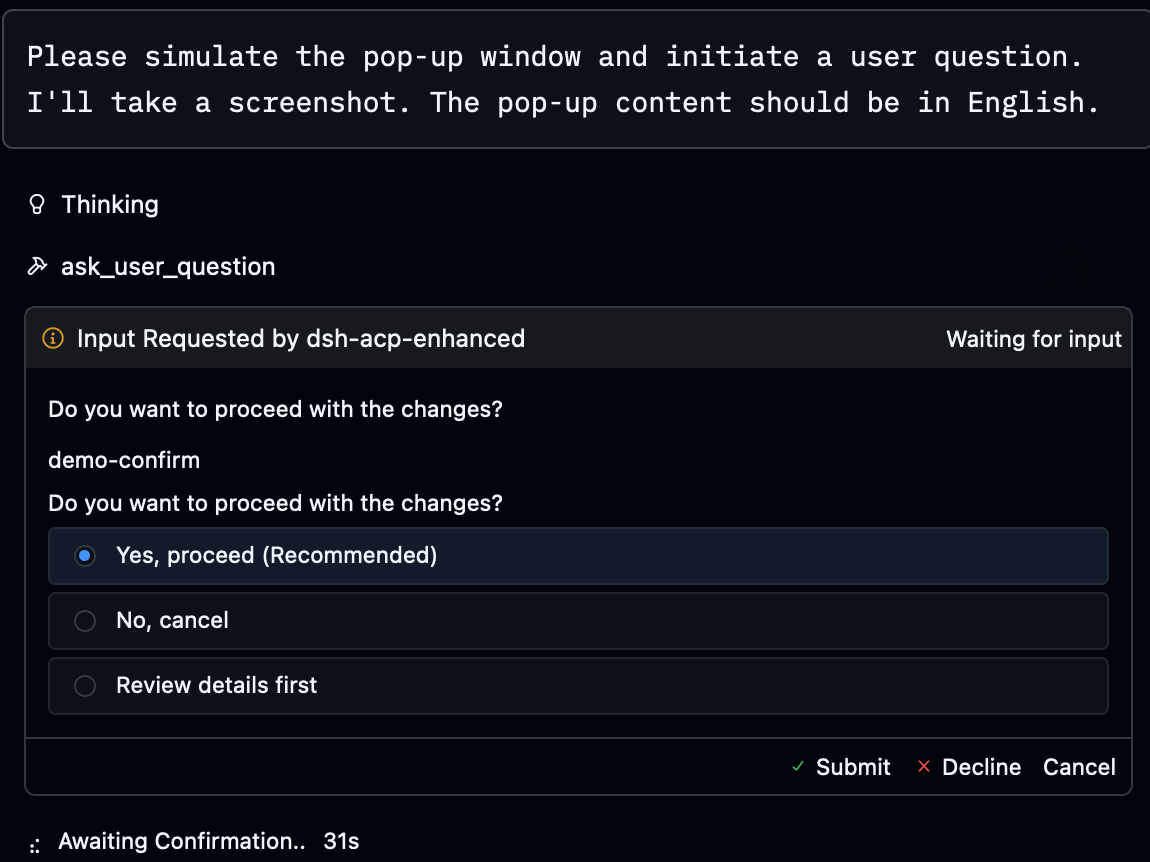
ask_user_question→elicitation/createform, click an option — or type a custom answer when none of them fit: options render with their descriptions, each option-backed question gets a free-text "Custom answer" field, and a custom answer replaces the single selection / accompanies a multi-select (same semantics as dsh's native question card) - Plan panel: plan mode toggle → "planning" status bar in Zed
Sessions
- Resume & archive:
session/loadrestores past threads (full replay);session/listlists the thread archive (titled, sorted by last activity);session/closedrops the in-memory record so a latersession/loadresumes from the persisted log; live title updates.session/deleteis deliberately not advertised — the harness declares no public persistence delete (see Compatibility) - Multi-root workspaces:
sessionCapabilities.additionalDirectoriesis advertised, so Zed no longer shows "this agent doesn't currently support multi-root workspaces" and instead passes every workspace root onsession/new/session/load. All roots are described to the model in the system prompt and reported onsession/list; the sandbox keeps the primarycwdas its single writable root (see Known limitations)
Commands
- Slash commands: typing
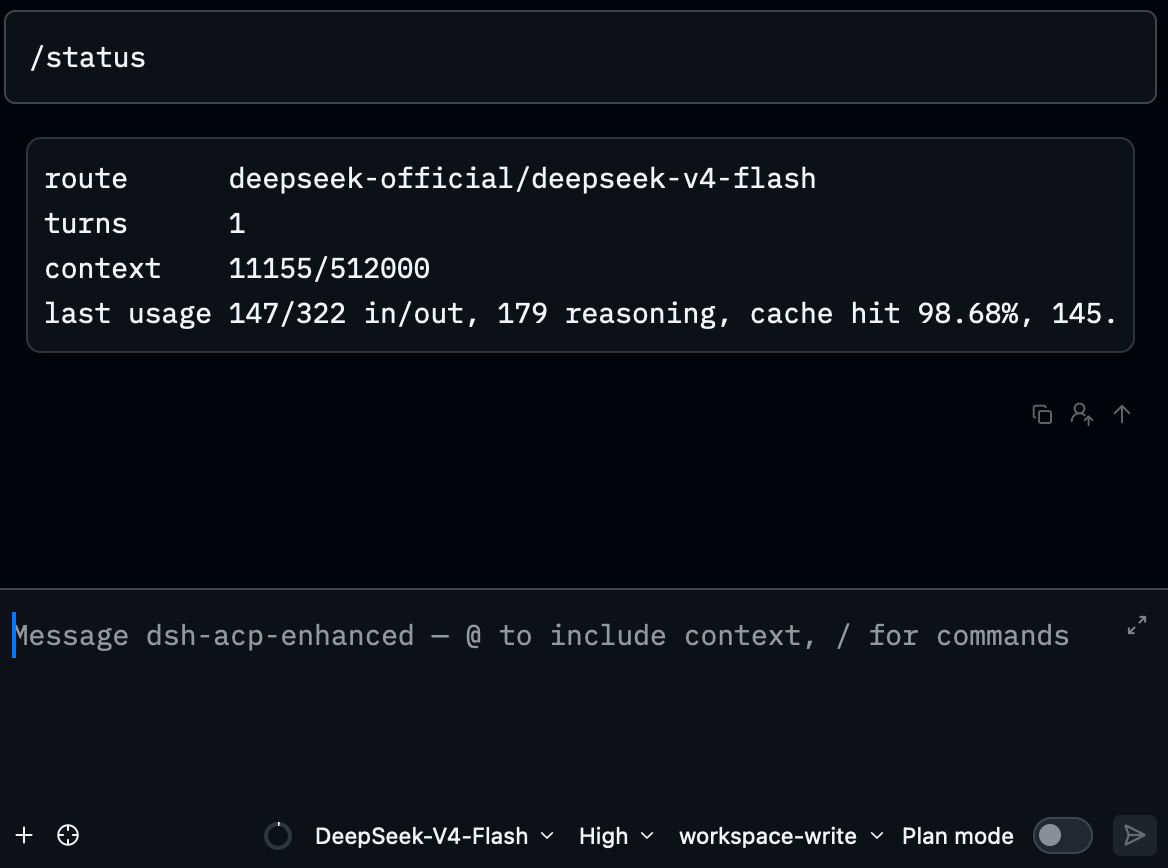
/reveals the command list (available_commands_update):/statusshows the route and telemetry,/modellists or switches the model,/presetlists or switches the agent preset (listings render as monospace code blocks — readable at a glance), everything else (/compact/goal/permission/plan…) runs straight through the harness command registry — all executed without a model turn. Every user-invocable skill is advertised as a command too, so/ask-matt,/code-review,/tdd, … reach the bridge instead of being rejected by the editor, and the skill's instructions are injected into the message (dsh-tool-skill-style user invocation). Images pasted next to a slash line ride along as command attachments (e.g. reference screenshots for a/goalobjective), the same way the Web composer submits them
MCP
- MCP servers:
session/newmcpServersmount any MCP server (stdio + streamable HTTP); tools join asmcp__<server>__<tool>; a failing server never takes the session down
Preview
After picking dsh-acp-enhanced in Zed's AI Agent panel:
Quick start
Requires dsh ≥ 0.1.5-rc.2 (npm install -g @deepseek-ai/dsh@0.1.5-rc.2); the bridge
targets one declared harness API line and does not probe older generations at runtime.
This package follows the official dsh plugin conventions (it declares dsh.bundle), so
installation matches any official bundle: one command — auto-initializes the profile,
installs the package, appends the bundle layer; no profile YAML to write.
Install (2 steps)
Step 1 — install (from the npm registry; no source checkout needed):
dsh plugin --profile acp-enhanced add dsh-acp-enhanced
When hacking on the code, use
link:to a local checkout instead (live edits):dsh plugin --profile acp-enhanced add "link:/absolute/path/to/dsh-acp-enhanced"
Step 2 — register in Zed (under agent_servers in ~/.config/zed/settings.json;
Zed spawns agents with a minimal PATH, so use the shipped launcher
scripts/dsh-acp-zed.sh, which locates node/dsh itself)
The launcher ships with the package. Its absolute path depends on how you installed in Step 1:
- npm install (default):
$HOME/.dsh/profiles/acp-enhanced/node_modules/dsh-acp-enhanced/scripts/dsh-acp-zed.sh— replace$HOMEwith your home directory (e.g./Users/you); Zed does not expand~or env vars, so write the full literal path.link:dev install:<your checkout>/scripts/dsh-acp-zed.sh.
Most common: DeepSeek official API (the default route)
{
  // ...your existing settings...
  "agent_servers": {
    "dsh-acp-enhanced": {
      "type": "custom",
      "command": "/bin/bash",
      "args": ["/absolute/path/to/dsh-acp-enhanced/scripts/dsh-acp-zed.sh"],
      "env": {
        "DSH_ACP_PROVIDER": "deepseek-official",  // the official provider id
        "DSH_ACP_MODEL": "deepseek-v4-flash",     // the official model id
        "DSH_ACP_PRESET": "standard"              // optional: agent preset id (minimal / standard / code / cordis / yours)
      }
    }
  }
}
Both env vars match the shipped patch's defaults, so they can be omitted entirely — writing them out just makes the route explicit.
DSH_ACP_PRESETdefaults tostandardon the roster side; set it when you want every new session to start in a specific mode. The API key does not have to live in Zed: store it in~/.dsh/.credentials.yaml(DEEPSEEK_API_KEY) and the dsh credentials service resolves it; the launcher also falls back to a runningdsh webprocess's key.
Debugging a stalled turn (is it the model request or the tool?):
"env": {
  // ...existing vars...
  "ACP_LOG": "/Users/you/.dsh/dsh-acp-enhanced.trace.jsonl"  // append-only JSONL event trace
}
Each line is one session event with wall-clock time (ms epoch); a turn that appears to
hang is attributable afterwards: a model request stall shows a long gap between
step/start and the first assistant/chunk, while a tool-execution stall shows a
long gap between tool/call and tool/result (the result line carries elapsedMs).
prompt/settled lines cover the full user-message round trip (stopReason + elapsed).
Optional: pin the panel's default config options (all still changeable in the panel):
"dsh-acp-enhanced": {
  // ...the type/command/args/env above...
  "default_config_options": {
    "model": "deepseek-official/deepseek-v4-flash",
    "agent_preset": "standard",
    "plan_mode": false,
    "reasoning_effort": "high"
  },
  "favorite_config_option_values": {
    "model": ["deepseek-official/deepseek-v4-flash", "deepseek-official/deepseek-v4-pro"]
  }
}
Extended: route through an OpenAI-Responses gateway (e.g. a company model gateway)
Same install path; only the env values change to the provider/model the gateway exposes plus the key env var it requires:
"dsh-acp-enhanced": {
  "type": "custom",
  "command": "/bin/bash",
  "args": ["/absolute/path/to/dsh-acp-enhanced/scripts/dsh-acp-zed.sh"],
  "env": {
    "DSH_ACP_PROVIDER": "<gateway-provider-id>",  // provider id exposed by the gateway
    "DSH_ACP_MODEL": "<gateway-model-id>",         // model id exposed by the gateway
    "<KEY_ENV_NAME>": "<key>"                      // the key env var the gateway reads
  }
}
<KEY_ENV_NAME>can also be omitted and the key stored in~/.dsh/.credentials.yamlinstead.
Zed hot-reloads settings. Open the AI Agent panel (Cmd+Shift+A) → pick
dsh-acp-enhanced in the agent selector → send your first message: replies stream in
real time, the status bar shows context usage, the panel exposes Model / Permission preset
/ Plan mode options plus three modes, and the thread archive lists and resumes past
sessions.
Verify locally (no Zed needed):
node <pkg>/scripts/acp-doctor.mjs              # bundles + versions, the peer range, and one real boot
node scripts/acp-client.mjs                    # dev checkout only: full ACP e2e, expect ALL CHECKS PASSED
DSH_ACP_PROVIDER=... DSH_ACP_MODEL=... node scripts/acp-client.mjs   # only for a custom route
Web search
The bridge ships no search provider and takes no position on which one you use: the
model-facing web_search tool rides on the web seam's searchProvider, so mount any
ctx.web provider into the profile — a package with dsh.bundle via
dsh plugin --profile acp-enhanced add <package>, or a plain package via your user-layer
insert rows (see below). Which provider exists in your dsh deployment is a profile
concern, not a bridge one.
Note what that costs: a provider bundle sits on the boot path of every ACP thread, so
if it fails to load, the whole profile dies and Zed shows an opaque hang. Prefer a preset
composition when the plugin only adds model-facing tools (see
Keep the profile minimal); a provider that must configure the
host web row belongs in the host composition (the profile) — mount it deliberately, and
re-run the doctor after changing it.
Managing the profile's plugins
dsh-acp-enhanced runs in its own profile — acp-enhanced, created at
~/.dsh/profiles/acp-enhanced/ — inside the same dsh home as dsh web. The profile is
what isolates the composition, so plugin changes here never affect your web setup,
while credentials, settings, sessions and presets stay shared.
The profile composes its plugin tree from three sources, each layer patching the ones before it:
- Bundle layers —
dsh.profile.bundlesin the profile'spackage.json: the template's@deepseek-ai/dsh-basefirst, then every installed package that declaresdsh.bundle(likedsh-acp-enhanced), in array order. - Your user layer —
~/.dsh/profiles/acp-enhanced/cordis.patch.yml: id-targeted row config overrides,disabled: truerow disables, andinsertlists (how a package withoutdsh.bundle— e.g. a hand-mounted custom provider — gets mounted). - Per-run overlays —
dsh --profile acp-enhanced --patch extra.yml.
Adjust the set with:
dsh plugin --profile acp-enhanced add <package>     # install; a dsh.bundle package auto-joins the layer stack
dsh plugin --profile acp-enhanced remove <package>  # uninstall; auto-leaves the stack
dsh plugin --profile acp-enhanced update [package]  # update one/all, then reconcile
dsh --profile acp-enhanced --dump-config             # inspect the composed tree (per-layer provenance)
dsh plugin is a thin pnpm forwarder (run inside the profile directory) that
reconciles dsh.profile.bundles against the installed state after every run. Two
consequences worth knowing:
-
Disabling a bundle by deleting it from
bundlesdoes not stick — the package is still an installed dependency, and the nextdsh pluginrun appends it right back. To disable a single row without uninstalling, target it in the user layer by its row id (not the package name — find ids in the--dump-configoutput):- id: mnemon disabled: true -
A package without
dsh.bundleloads nothing by itself — it installs as a plain dependency (with a one-time warning) and needs your owninsertentry in the user layer. To change an existing row's config, override it with- id: <row>+config:— patch entries replace the whole row config, they do not merge.
Changes take effect in the next process: Zed spawns a fresh
dsh --profile acp-enhanced for every agent thread, so open a new agent thread (or
restart Zed) after editing the profile.
Keep the profile minimal
The profile is a single failure domain. cordis-plugin-loader awaits every entry and
rethrows the first rejection, so one unloadable row aborts the whole plugin tree: the
process may even answer the ACP initialize handshake first and die right after, which a
client reports as an opaque hang, not an error.
Keep dsh.profile.bundles at exactly the two rows that cannot mismatch their own boot:
"bundles": ["@deepseek-ai/dsh-base", "dsh-acp-enhanced"]
@deepseek-ai/dsh-base ships with the CLI, so its version always matches the CLI that
boots it; every other bundle is a third party whose dependency closure can drift. Mount
extra plugins where a failure costs one preset instead of the whole editor session:
- Plugin adds only model-facing tools/commands → declare its row in a preset
composition. User presets live in
$DSH_HOME/.agent-presets/<id>/(agent.cordis.ymlfor the composition,preset.ymlfor the picker label); the roster discovers them automatically and the ACPagent_presetdropdown lists them. A preset whose composition fails to load is reported as broken and simply not offered, instead of killing the process. - Plugin must configure a host service (e.g. a search provider overriding the host
webrow'ssearchProvider) → it belongs in the host composition, i.e. the profile. That is a deliberate trade: accept the boot-path risk, and re-run the doctor after any change.
Check the result before trusting it:
node <pkg>/scripts/acp-doctor.mjs          # bundles + versions, the peer range, and one real boot
dsh --profile acp-enhanced --dump-config   # where each row comes from
Compatibility
One bridge binary, one harness API line: dsh ≥ 0.1.5-rc.2 (peer range
^0.1.5-rc.2 || ^0.1.6-alpha.1). Both lines in that range are boot-verified —
handshake, profile settle and a real session/new — on every CI run, plus a cross-generation
link check. The bridge consumes only the harness's declared surface: services in
docs/capability-seams.md, events in docs/event-producer-consumer.md, published package
exports. scripts/api-surface-check.mjs fails on anything else (a blocking CI step), and
there is no runtime generation probing left — no version flags, no duck-typed service shapes.
Support policy
| Bridge | Supported dsh lines | What changed |
|---|---|---|
| 0.9.x | ^0.1.5-rc.2 || ^0.1.6-alpha.1 |
declared-surface-only rewrite; floor 0.1.5-rc.2; session/delete dropped |
| 0.8.x | ^0.1.0-rc.6 … ^0.1.6-alpha.1 (unreleased) |
0.1.3+ live-stream seam; 0.1.5 persistence handle API |
| 0.7.x and older | ≤ 0.1.2-rc.1 | runtime probing of both generations |
The rules behind that table:
- A new dsh API line gets a new bridge release, not a wider runtime probe. Probing is how 0.7.x absorbed 0.1.1 → 0.1.5, and it is why that support rotted silently.
- The floor moves only with a bridge minor, and never silently: the launcher warns before
booting a CLI below the range, and the doctor stops with
RESULT FAIL — CLI too old. - A line is dropped by publishing a bridge that says so; the previous line stays on the
feat/dsh-0.1.3-plus-supportbranch for users who cannot move. - Watch the next line before it is released: the scheduled
canaryworkflow installs thealphadist-tag and runs the guard, the link check and a boot smoke, so a breaking change shows up as a red canary rather than as user breakage.
What 0.9.0 changed (breaking)
| Change | Effect | If it bites |
|---|---|---|
| floor raised to dsh ≥ 0.1.5-rc.2 | older hosts fail at mount time with a named error instead of degrading silently | upgrade the CLI (npm install -g @deepseek-ai/dsh@0.1.5-rc.2), or stay on the feat/dsh-0.1.3-plus-support branch for ≤ 0.1.2-rc.1 |
session/delete removed |
the ACP capability is no longer advertised and persisted sessions are never deleted — the harness declares no public persistence delete | the files stay under $DSH_HOME/sessions/<slug>/<id>/; remove them by hand if you must. An upstream issue tracks a public delete API |
the launcher no longer rewrites DSH_HOME |
the ACP profile boots inside the home the launcher was started with (${DSH_HOME:-$HOME/.dsh}), sharing credentials, settings, sessions and presets with dsh web |
used the old implicit ~/.dsh-acp? Point the launcher at it explicitly ("DSH_HOME": "<home>/.dsh-acp" in Zed's agent_servers.env) or migrate back to the shared home |
the assistant/chunk seam is gone |
live streaming is agent/assistant-stream only (the floor carries it) |
upgrade the CLI; a host that streams nothing is still covered by the committed assistant/message fallback |
Upgrading from a published ≤ 0.7.0
The published latest is 0.7.0, from the pre-0.1.3 API line, so the bridge and the CLI
have to move together — in either order the half-upgraded pair is broken:
| Order | What you get |
|---|---|
| CLI first, bridge left at 0.7.0 | The profile boots and initialize succeeds, but every session/new fails with an Internal error (tool-subagent: modelSelectionSettings requires … in the Host scope). Nothing can warn you: that bridge copy is already installed, and it also has no agent/assistant-stream seam and no assistant/message fallback, so replies would not render either |
| Bridge first, CLI left behind | The profile dies while loading (… subpath './model-selection-settings' is not defined by "exports"). The launcher warns on stderr before that, and scripts/acp-doctor.mjs stops with RESULT FAIL — CLI too old |
| Both together | The supported state |
Checklist:
npm install -g @deepseek-ai/dsh@0.1.5-rc.2(or any version in the peer range above).dsh plugin --profile acp-enhanced add dsh-acp-enhanced@0.9.0. Upgrading the bridge is explicit: the profile's dependency is a caret on 0.x, sodsh plugin updatewill not move you to a new minor by itself.- Booted the profile from a checkout, or set
DSH_PATHbefore? The old launcher moved you to~/.dsh-acpon its own; it does not any more. SetDSH_HOME=<that home>in Zed'sagent_servers.env, or recreate the profile in your default home. The launcher says so if it finds a profile there. - Followed the old README and seeded
subagent-model-selection-settingsin your profile's user layer? Delete the row: the bridge's patch ships it now, and a duplicate id aborts the boot.scripts/init-acp-home.shretires it for you. The launcher warns, and the doctor names the id. - Check that any third-party bundle in the profile supports 0.1.5 (
dsh-free-search≥ 0.4.24 is verified) — the profile is one failure domain. - Restart Zed (or open a fresh agent thread);
node <pkg>/scripts/acp-doctor.mjsverifies the whole path first, including opening a thread.
One CLI generation per home
$DSH_HOME/profiles/node_modules is a single dependency closure shared by every profile
under that home, and dsh heals it to whichever CLI booted last. So:
This is 0.1.5-line behaviour. On 0.1.6-alpha.2 that shared closure no longer exists at all (the harness resolves from the CLI's own install; the profile's
node_modulesholds only out-of-tree plugins), which is why the launcher's drift check is line-specific and silently no-ops where the path is gone.
- Never run two CLI generations under one home at once. The second boot flips the
closure under the first process, which then lazily resolves mismatched modules
mid-flight. The launcher compares the closure's
dsh-agentversion with the CLI it is about to boot and warns on stderr when they differ — after such a boot, restart the other dsh processes under that home (dsh web, …). - The escape hatch is the CLI, not the home. Pin the launcher with
DSH_PATH=<dsh>(or use the repo pin below): the launcher resolves which dsh, never which home.
Current resolutions are always visible:
node scripts/compat-check.mjs   # dev checkout: installs the 0.1.5-rc.2 and 0.1.6-alpha.2 sets and imports the bridge from each
node <pkg>/scripts/acp-doctor.mjs   # CLI + closure versions, bundles, and one real boot (shipped)
Dev checkout: repo-pinned CLI, shared home
When the launcher runs from a checkout (link: install), it resolves the dsh CLI in
this order:
$DSH_PATH— an explicit dsh binary, or a directory whosenode_modules/.bin/dshholds one- the repo-pinned CLI —
<repo>/node_modules/.bin/dsh(this package's@deepseek-ai/dshdevDependency, currently 0.1.5-rc.2) - global fallback —
dshon PATH / npx cache / npm prefix (a fresh clone withoutpnpm installdegrades to it)
Whichever wins boots profile acp-enhanced in the home the launcher was started with
(${DSH_HOME:-$HOME/.dsh}). The home is never rewritten. If you want the bridge on its
own dependency closure, build a separate home and point the launcher at it explicitly:
DSH_ACP_HOME=~/.dsh-acp scripts/init-acp-home.sh   # optional, idempotent: creates + seeds an isolated home
# then in Zed's agent_servers env:  "DSH_HOME": "/Users/you/.dsh-acp"
The isolated home is a deliberate opt-in, not a default: your profile must exist in
whichever home the launcher boots, or it exits 127 with the exact dsh plugin … add link:
command that creates it. init-acp-home.sh ports your old profile's user rows verbatim,
copies credentials/settings, disables the DeepSeek plugin-package inventory reporter, and
retires a legacy subagent-model-selection-settings row from the user layer — that host
row now belongs to the bridge's bundle patch, and a second copy aborts the boot with
duplicate loader entry id.
更多「集成与分享」插件
dsh-notification
作者 omdsh-dev
DeepSeek Harness 桌面通知插件,任务完成时提醒,可按结果与关键词规则控制。
dsh-open-in-vscode
作者 omdsh-dev
从 DSH Web 界面直接以 VS Code 打开工作区目录。
fn-os-apps
作者 tnnevol
飞牛 fnOS 应用 Monorepo
dsh-lark-bot
作者 plutokeating
DeepSeek Harness (dsh) 接入飞书/Lark bot,扫码即用:流式卡片、项目工作区、并行任务、多角色 Agent、跨会话通知、对话内模型/密钥管理与安全网守护(dsh 崩溃后飞书仍可自救)。A scan-to-connect bridge bot connecting DeepSeek Harness (dsh) into Feishu/Lark: streaming cards, workspaces, parallel tasks, multi-role agents, cross-session notify, in-chat model/key management, and a safety-net guardian.