
README
MCP Lens for DeepSeek Harness
English | 简体中文


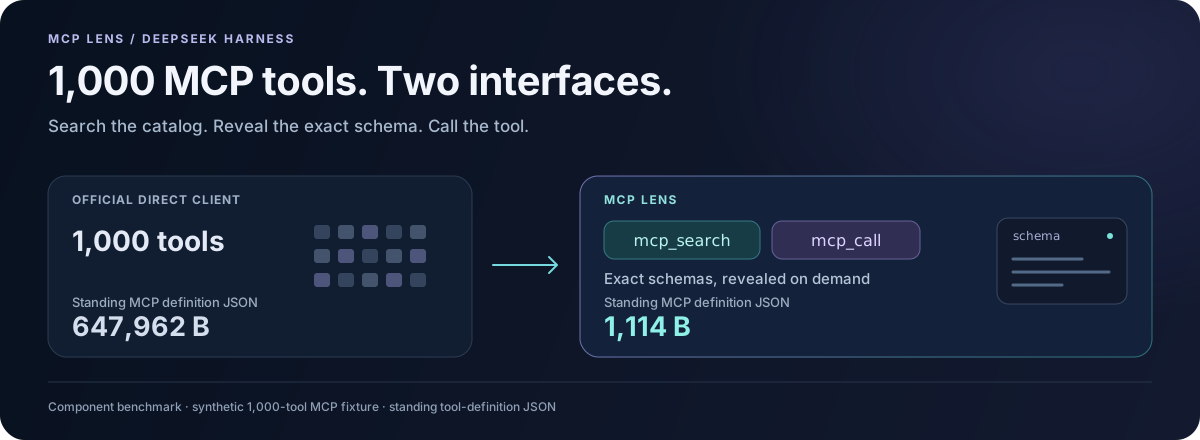
1,000 MCP tools. Two interfaces. Exact schemas when you need them.
Install · Try the 1,000-tool calculator · See product tests
Large tool catalogs take up room before the model starts solving your task. MCP Lens keeps the standing MCP definitions small, finds relevant tools across servers, and preserves the returned data needed by the next call.
MCP Lens gives DeepSeek Harness two model-facing tools:
mcp_searchfinds relevant tools and returns their exact input schemas.mcp_callcalls a specificserver/tooland returns its result, including structured data.
The two tool definitions occupy 1,114 bytes of JSON, regardless of catalog size. In the 1,000-tool component fixture, the direct client's definitions occupy 647,962 bytes. Remote schemas enter the conversation when search returns them. Connections open on demand, and repeated searches reuse the catalog index.
The latest version also fixes multi-step workflows: a customer ID returned alongside a text summary stays visible, so the model can use it to look up the customer's order. The tested data flows improved from 10/12 to 12/12. Read the September 10 results.
This works well for dozens to thousands of tools spread across MCP servers. Search adds a step; for a few tools used on nearly every request, the official direct MCP client is simpler.
Install
Use Node.js ^22.19.0 || >=24.0.0 and Harness 0.1.2-rc.1. As of September 10, 2026, Harness's npm latest and next tags point to this version.
Build Lens rc.10 from the main branch below. The published npm package is still rc.9, which targets Harness 0.1.0-rc.6.
npm install -g @deepseek-ai/dsh@0.1.2-rc.1
git clone https://github.com/labmimors/dsh-mcp-lens.git
cd dsh-mcp-lens
npm ci --ignore-scripts
npm run build
npm pack --ignore-scripts
dsh plugin --profile web add ./dsh-mcp-lens-0.1.0-rc.10.tgz
dsh plugin uses pnpm. If pnpm is missing from PATH, replace the last command with:
npm exec --yes --package=pnpm@10.20.0 -- dsh plugin --profile web add ./dsh-mcp-lens-0.1.0-rc.10.tgz
If you are keeping an existing Harness 0.1.0-rc.6 installation, use dsh plugin --profile web add dsh-mcp-lens@0.1.0-rc.9.
Connect your first MCP server
The plugin starts with no servers. Open ~/.dsh/profiles/web/cordis.patch.yml, or $DSH_HOME/profiles/web/cordis.patch.yml if you set DSH_HOME.
Replace an empty [] with this block. If the file already has other entries, append it as another top-level item; if it already has an mcp-lens item, replace that item's config.
- id: mcp-lens
  config:
    servers:
      - name: mcp-docs
        transport: streamable-http
        url: https://modelcontextprotocol.io/mcp

    cachePath: !!js dshHomePath('mcp-lens/catalog.json')
    allowTools:
      - mcp-docs/search_model_context_protocol
      - mcp-docs/query_docs_filesystem_model_context_protocol
    denyTools: ['mcp-docs/submit_feedback']
This connects the official MCP documentation server and enables its two read-only query tools. The server needs no API key; Harness uses the model provider you have configured.
Check the configuration and start Harness:
dsh --profile web --dump-config
dsh --profile web
Then ask:
Use the official MCP documentation server to explain when an MCP client should use Streamable HTTP.
Ask normal questions. The model uses mcp_search and mcp_call as needed.
Configuration
Set servers, cachePath, and the tools you want in allowTools. Patterns match server/tool, with * as a wildcard. denyTools overrides allowTools; an empty allow list enables no tools.
Each Cordis patch replaces the item's whole config, so include all custom settings you want to keep.
Local stdio server
- id: mcp-lens
  config:
    servers:
      - name: local
        transport: stdio
        command: node
        args: ['/absolute/path/to/mcp-server.mjs']
        cwd: /absolute/path/to/project

    cachePath: !!js dshHomePath('mcp-lens/catalog.json')
    allowTools: ['local/search_*', 'local/read_*']
    denyTools: ['local/delete_*']
Replace the command, paths, and tool patterns with those of your MCP server.
Authenticated HTTP server
- id: mcp-lens
  config:
    servers:
      - name: knowledge
        transport: streamable-http
        url: https://mcp.example.com/rpc
        headers:
          Authorization: !!js '`Bearer ${process.env.MCP_TOKEN}`'
        cacheNamespace: knowledge-acme-readonly

    cachePath: !!js dshHomePath('mcp-lens/catalog.json')
    allowTools: ['knowledge/read_*', 'knowledge/search_*']
    denyTools: ['*/delete_*', '*/destroy_*']
cacheNamespace identifies the account and permission scope, without containing a credential. Change it when the account or scope changes. Without it, an authenticated server's catalog stays in memory and is fetched again after restart.
Timeouts, search limits, and catalog settings
| Field | Default | Purpose |
|---|---|---|
catalogTtlMs |
86400000 |
Refresh a catalog after 24 hours |
idleDisconnectMs |
300000 |
Close an idle connection after 5 minutes |
connectTimeoutMs |
30000 |
Connection timeout |
callTimeoutMs |
60000 |
Tool-call timeout |
discoveryTimeoutMs |
30000 |
Timeout for the full catalog discovery |
maxDiscoveryPages |
1000 |
Pages per discovery |
maxToolsPerServer |
10000 |
Tools per server |
maxBytesPerTool |
1048576 |
Metadata bytes per tool |
maxTotalCatalogBytes |
67108864 |
Total catalog/cache bytes |
maxHttpResponseBytes |
16777216 |
HTTP response bytes |
maxCursorBytes |
4096 |
Pagination cursor bytes |
searchLimitDefault |
5 |
Default search results |
searchLimitMax |
10 |
Maximum search results |
The defaults are also in cordis.patch.yml.
A failed refresh keeps the previous usable catalog, and one unavailable server does not hide results from other servers. Lens supports MCP Tools over stdio and Streamable HTTP. OAuth, Resources, Prompts, Elicitation, and task-based execution are not currently implemented.
Latest tests
The latest change makes structured results visible to the model, including identifiers needed by later calls.
| Test | Result |
|---|---|
| Automated tests | 178 passed |
| Three Codex model tasks with 16 synthetic tools | Lens 3/3; official direct client 2/3 |
| Data workflows across 16- and 1,000-tool catalogs | 12/12 after the fix; 10/12 before |
| Lens tool definitions | 2 schemas, 1,114 B |
The model tasks ran in Codex through real Harness ToolRuntime and MCP servers. See Product tests for the tasks, results, and reproduction commands.
Earlier experiment: DeepSeek V4 Flash pilot, August 14, 2026.
Try it on your catalog
Open the schema calculator, load the 1,000-tool sample or paste your exported tool definitions, and compare the standing schema size. Use Copy share link, Copy Markdown, or Download card to share your measurements with teammates. Calculation runs in your browser; the share link contains the numeric result.
Have a query that misses the right tool? Send a minimal search example so we can reproduce it. You can also browse MCP Lens in the DSH Directory.
Development
Run these commands from the source checkout:
npm ci
npm run verify
npm run bench -- --output benchmark.json
npm run verify:dsh-install
npm run verify:dsh-profile
verify runs type checking, tests, and the build. The install checks use local MCP fixtures and temporary Harness profiles. If Corepack is unavailable, run the profile check through npm exec --yes --package=corepack@0.35.0 -- npm run verify:dsh-profile.
See Contributing for exact Harness versions, test commands, and the schema-size GitHub Action.
更多「MCP 與協定」外掛
ruflo
作者 ruvnet
原版智慧體元框架(meta-harness):支援多智慧體叢集部署、自主工作流編排與對話式 AI 系統構建,內建自適應記憶、自學習智慧與 RAG 檢索,原生整合 Claude Code / Codex / Hermes 等大量工具。
reactive-resume
作者 reactive-resume
開源簡歷製作外掛,強調隱私保護,支援自定義、可移植和自託管。
everos
作者 evermind-ai
為所有 AI 智慧體提供的便攜統一記憶層,本地優先、Markdown 原生、資料歸使用者所有,跨應用與工作流自進化。
yao
作者 yaoapp
在桌面、移動端、瀏覽器或 API 上統一管理你的智慧體與工作區,看板式任務追蹤,支援自託管。