
README
DSH Subagent Model Router
Give every delegated task the right model—automatically.
Stop using one model for every kind of work. Configure your preferred fast, affordable, specialized, and high-reasoning models once; the router gives your agent the aliases, tags, and guidance it needs to intelligently select the best route for each delegated task.
That means faster routine work, stronger results on difficult problems, better control over cost, and less model micromanagement. Subagents can run in parallel, their results are reliably joined before the parent responds, and the model chosen for each task stays visible throughout the UI.
Why use it?
- Better results where they matter — reserve your strongest models for architecture, security, deep reasoning, or critical review.
- Lower cost and latency — send routine searches, edits, and focused implementation work to faster or more economical routes.
- Automatic, task-aware routing — friendly aliases, capability tags, and plain-language usage guidance help the orchestrator choose intelligently.
- Confident parallel delegation — launch multiple specialists in the background and reliably collect every result before synthesis.
- Clear model visibility — see which model actually handled a task in subagent headers, catalog rows, and Better Sidebar's Tasks view.
- Easy setup — configure your model team from the Web UI, through a guided skill, or directly in
settings.yaml.
[!TIP] Already using Better Sidebar? The router adds an optional Sub-agents tab through Better Sidebar's public
registerTabAPI.
See it in action
Follow every specialist from Better Sidebar
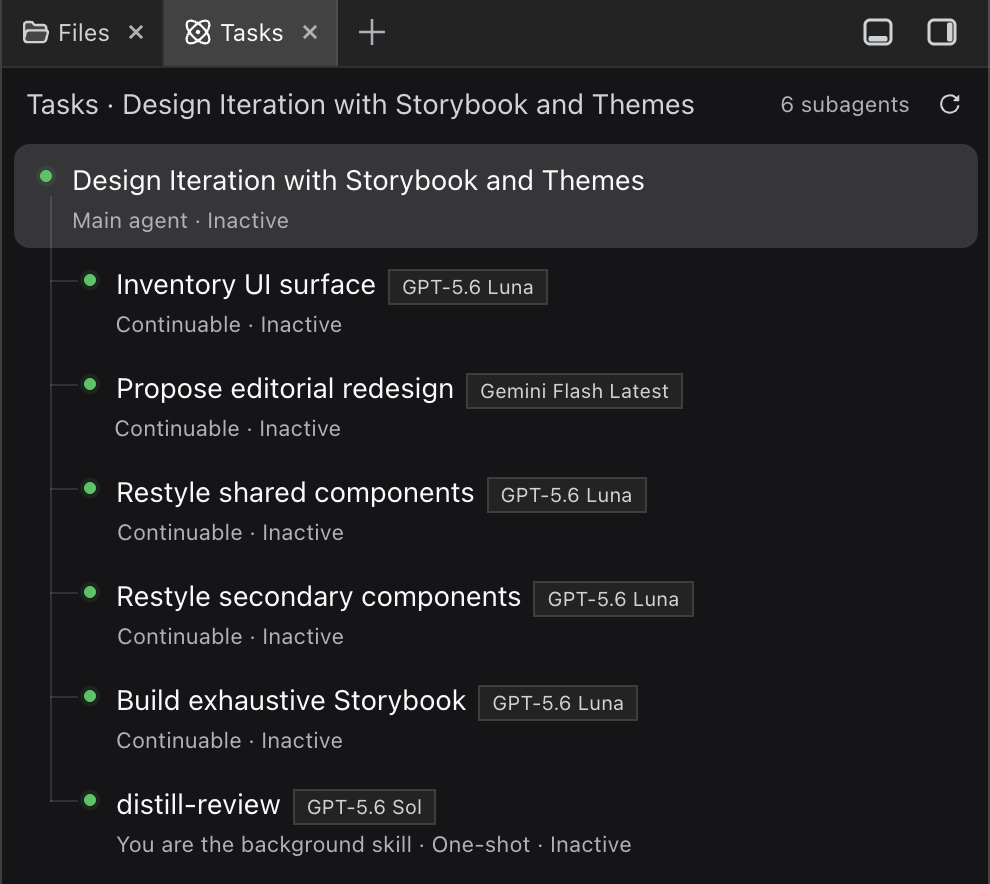
See parallel delegated work, current status, and the selected model together in the task tree you already use.
Build your ideal model team
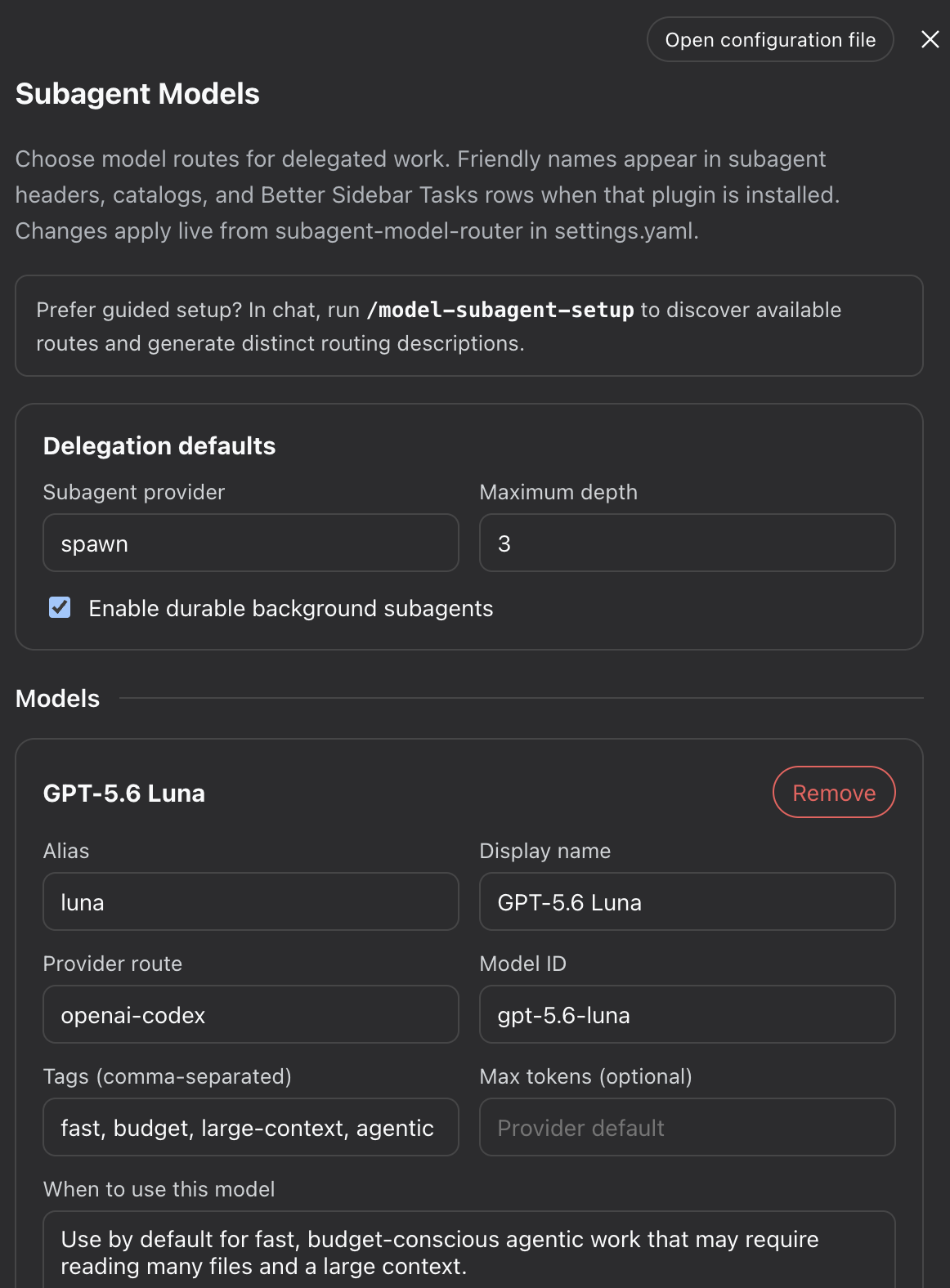
Define friendly routes and tell the orchestrator when each model shines—from quick, budget-friendly tasks to your most demanding work.
What it adds
subagent_model: a delegation tool whosemodelargument is restricted to user-configured aliases.wait-for-subagents: a join tool that waits for this agent's outstanding continuable background children, including standard and model-routed delegations, and returns their terminal results.- Per-model tags and routing descriptions embedded in the tool schema and system prompt.
model_subagent_catalog: a read-only view of models advertised by registered LLM providers.configure_subagent_models: a namespace-scoped model-facing tool for reading or updating this plugin's settings without filesystem access.model-subagent-setup: a guided skill for selecting routes, generating routing guidance, obtaining confirmation, and saving through the constrained configuration tool.- Settings → Subagent Models: a Web settings page for manually adding, editing, and removing routes.
- A hot-reloaded
subagent-model-routernamespace in~/.dsh/settings.yaml. - Foreground execution and durable continuable background subagents.
- Configurable stale-subagent filtering for listing tools, defaulting to 20 parent/user message turns without contact.
- An active-model chip in an opened subagent header.
- Active-model chips in healthy rows of the parent session's subagent catalog.
- An optional Better Sidebar Sub-agents tab registered through the public sidebar service (when installed).
- Activity-sorted catalog trees: running branches first, resident idle branches next, and inactive-only branches in collapsed Inactive (N) collections. Active descendants keep their ancestry visible; unknown or unloaded branches remain visible until their state is known. Ordering updates with session activity and preserves sibling order within each status.
With an empty models list, the catalog, configuration, and wait tools remain available alongside the settings page and setup skill, but subagent_model is not registered. This provides a bootstrap state for initial setup.
Orchestrator behavior
When model-selectable delegation is available, the system prompt tells the orchestrator not to duplicate work it delegated. After issuing all intended background delegations, it must call wait-for-subagents before synthesizing the child results or giving a final answer. While a same-session completion goal is active, the orchestrator must not merely report that another model is handling the task and end its turn with background subagents still outstanding: ending the turn triggers immediate goal continuation and can race child tracking. Waiting joins the outstanding work so the orchestrator can synthesize the results and continue or complete the goal. The wait tool joins every continuable background child started by that parent through subagent, subagent_fork, subagent_model, or auto_agent_run; it remains useful when no model routes are configured. It reserves standard, forked, and project-specialist delegation calls before they can publish a child, and after plugin reload it discovers direct continuable children when their durable descriptors confirm their mode and the live Agent is either running or interrupted with parked input (reported separately as paused). It preserves every terminal content block and drops retained records when the parent is disposed, while foreground one-shot runs and job-backed non-continuable delegations remain outside this join because their owning tool already returns or collects the result.
更多「整合與分享」外掛
dsh-notification
作者 omdsh-dev
DeepSeek Harness 桌面通知外掛,任務完成時提醒,可按結果與關鍵詞規則控制。
dsh-lark-bot
作者 plutokeating
DeepSeek Harness (dsh) 接入飛書/Lark bot,掃碼即用:流式卡片、專案工作區、並行任務、多角色 Agent、跨會話通知、對話內模型/金鑰管理與安全網守護(dsh 崩潰後飛書仍可自救)。A scan-to-connect bridge bot connecting DeepSeek Harness (dsh) into Feishu/Lark: streaming cards, workspaces, parallel tasks, multi-role agents, cross-session notify, in-chat model/key management, and a safety-net guardian.
dsh-session-notification
作者 dingyi222666
為 Deepseek Harness 提供會話完成等四種狀態的通知響應,支援瀏覽器提示和提示詞
dsh-chatgpt-web
作者 wlv-zedd
將標準 ChatGPT Web 直接橋接到 DeepSeek Harness 的 DSH ChatGPT Free 外掛。